Small children's rooms are a design challenge that most parents face. Children need space to play, but many bedrooms — particularly in flats, terraces, and older houses — were never designed with active children in mind. This guide covers the furniture choices that genuinely work in small spaces, without sacrificing the play value that makes childhood worth having.
The Core Problem With Small-Room Furniture
The mistake most people make is buying furniture designed for large rooms and trying to make it fit. Scaled-down versions of adult bedroom furniture — tiny wardrobes, miniature desks, compact dressing tables — fill the room visually without adding much to a child's life.
The better approach: choose furniture with high play value, a small physical footprint, and dual function. In a small room, every piece needs to earn its space. The question to ask isn't "does this fit?" but "does this justify the floor area it takes?"
The Case for Floor-Level Furniture
In a small room, the floor is your greatest asset. Low, floor-level furniture that doesn't create visual barriers keeps the room feeling open and gives a child the maximum usable space for play.
Bean bags are the perfect small-room seating solution. When not in use, a bean bag can be pushed into a corner, tucked under a loft bed, or moved to the living room. They take up essentially no fixed footprint — they're portable, movable, and add real character. Our [children's bean bags](/shop/bean-bags) come in animal prints and solid velvet colours and arrive vacuum-packed, expanding to full shape within 48 hours.
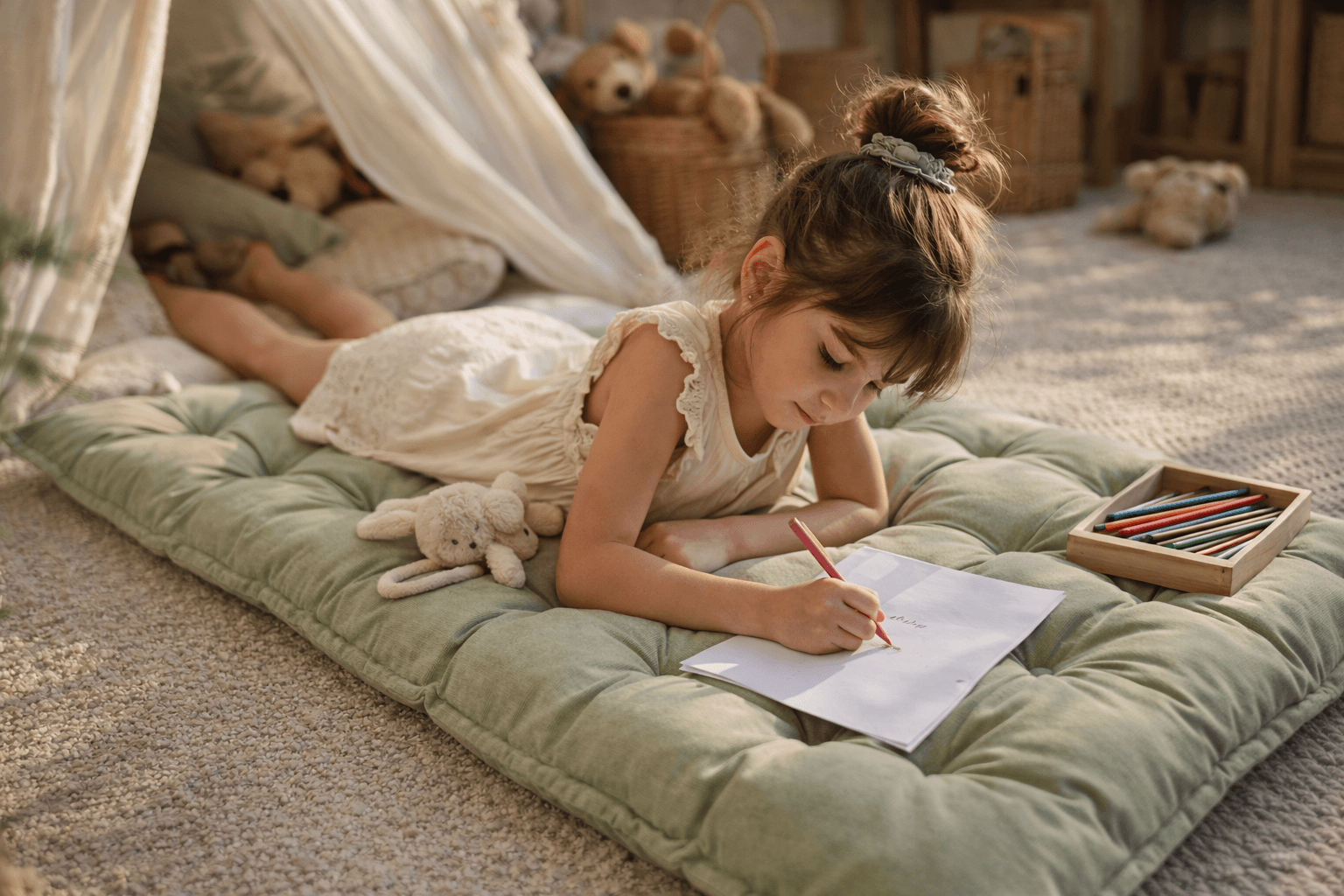
Floor cushions work similarly. Our [floor cushions for children](/shop/floor-cushions) stack flat against a wall when not in use and come out for reading time, group play, or when a friend visits. Available in three sizes, they replace what might otherwise be a large sofa that dominates a small space — with far more flexibility.
Furniture That Does Two Things
In a small room, dual-function furniture is worth twice as much as single-purpose pieces.
Our children's sofas unfold completely flat into a sleeping mattress, then reassemble in seconds. In a room that can't fit a permanent guest bed, this matters enormously: sleepovers become possible without the room needing to house a fold-out frame. During the day it reads as a sofa; at night it becomes a proper bed. Browse our [children's sofas](/shop/sofas) to see the modular designs available.
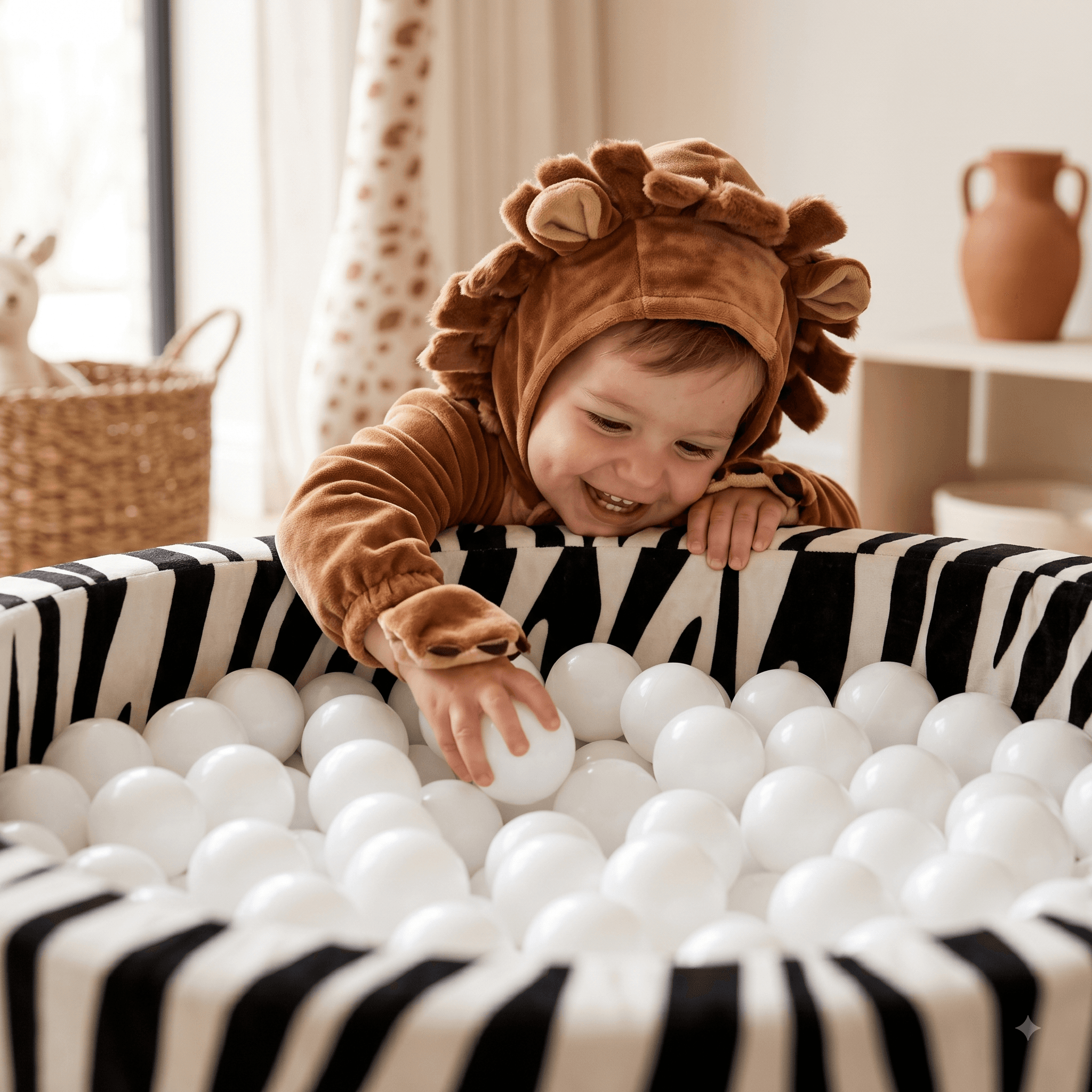
Ball pits in small rooms sound counterintuitive, but the insight is that they define the play space. Rather than toys scattered across the entire floor, a ball pit gives children a contained play zone. When playtime is over, the balls stay inside and the room remains walkable. Our [ball pits for children](/shop/ball-pits) have foam walls that hold their shape and a machine-washable cover — they're a dedicated play corner that occupies one zone of the room cleanly.
Using Vertical Space
In a small room, the floor competes with everything. Vertical space rarely does.
A cocoon swing hung from the ceiling takes essentially zero floor space and adds an entirely different dimension to play. The fixed footprint of a ceiling-hung swing is nothing — it uses air, not floor area. Our [cocoon swings](/shop/swings) are rated to 100 kg and require only a fixed ceiling hook into a joist. They suit rooms that can't accommodate more furniture on the floor but have ceiling height to spare.
Wall-mounted shelving for books, art, and small toys keeps surfaces clear. The rule in small rooms: if it can go on a wall, it should.
Colour Strategy for Small Rooms
Colour in a small room is a genuine design lever. The right choices make a space feel significantly larger; the wrong ones make it feel cramped.
For small children's rooms:
- One statement colour in key furniture pieces, against neutral walls. Our bean bags in BLOOM pink or HONEY yellow add energy and personality against white or cream without dominating.
- Light, warm neutrals on walls — not stark white, which reads cold; a warm off-white or cream bounces light and feels open.
- Consistent flooring where possible — the eye reads an unbroken floor as more spacious.
Avoid: too many competing accent colours, dark walls in already-dim rooms, large-scale wallpaper patterns that become visual noise in tight spaces.
The Combination That Works Best
For a children's room under 10 m², the combination we consistently see work well:
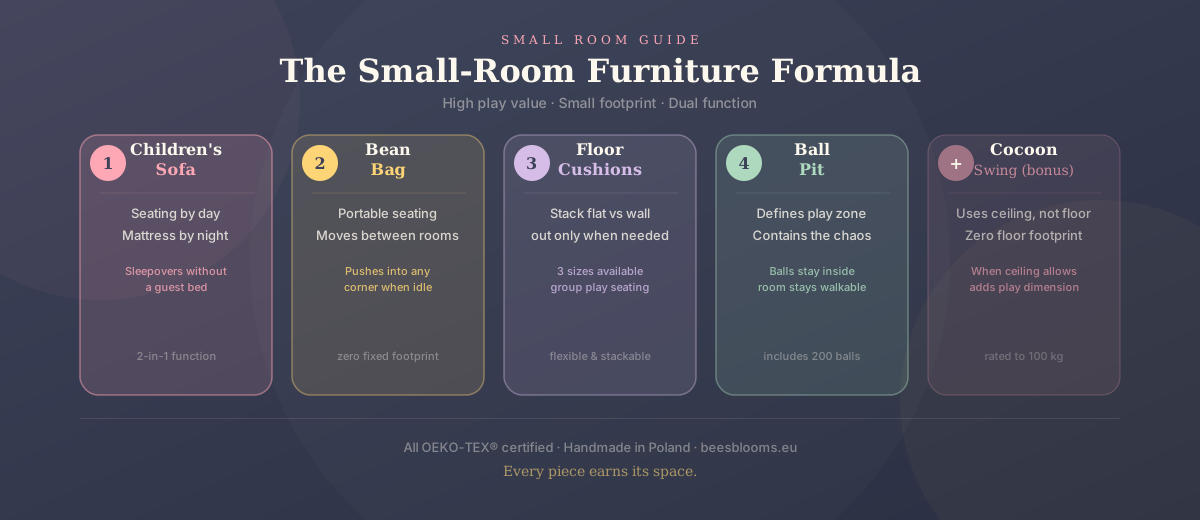
- 1A children's sofa — provides seating and converts to a sleep surface for guests
- 2One bean bag — secondary seating, completely portable
- 3Two or three floor cushions — flexible for group play, stack flat when not needed
- 4Wall-mounted shelving — keeps the floor clear
This setup handles reading, independent play, small-group play, and sleepovers — all without eating the floor. None of it becomes age-inappropriate quickly, so it grows with the child.
A [cocoon swing](/shop/swings), if the ceiling allows it, adds a genuinely distinct play element with zero floor cost. For rooms where the floor is simply too contested, it's often the best solution available.
The best small-room strategy is this: put nothing on the floor that doesn't need to be there, and make everything that is on the floor do more than one job.