An indoor swing chair for children might be the most divisive piece of children's furniture there is. Parents who have them love them. Those who've hesitated often come back to them after seeing one in action. If you're weighing whether it's right for your home, this guide covers the practical and developmental case — and what to check before you buy.
Why Children Love to Swing: The Vestibular System
Children crave swinging motion for a reason that runs deeper than entertainment. Swinging directly stimulates the vestibular system — the sensory system housed in the inner ear that processes movement, balance, and spatial orientation.
For children, the vestibular system is in constant active development. Regular vestibular input (rocking, swinging, spinning) strengthens this system and contributes to balance, coordination, and the ability to focus. Children who don't get enough vestibular stimulation often seek it compulsively — by rocking, fidgeting, or running when stillness is expected.
This is why many occupational therapists include swing-based activities in therapy programmes, and why children with access to indoor swings often gravitate to them between activities as a self-regulating tool.
Cocoon vs Open Chair: Which Shape Is Right?
Indoor swings for kids come in two main shapes: open chair swings (which look like a hammock or rope seat) and cocoon swings (which enclose the child partially in a pod shape).
Open chair swings give more freedom of movement. Children can sit facing outward, lean back, or use them in a more active, playful way. They suit older children and outdoor-adjacent use.
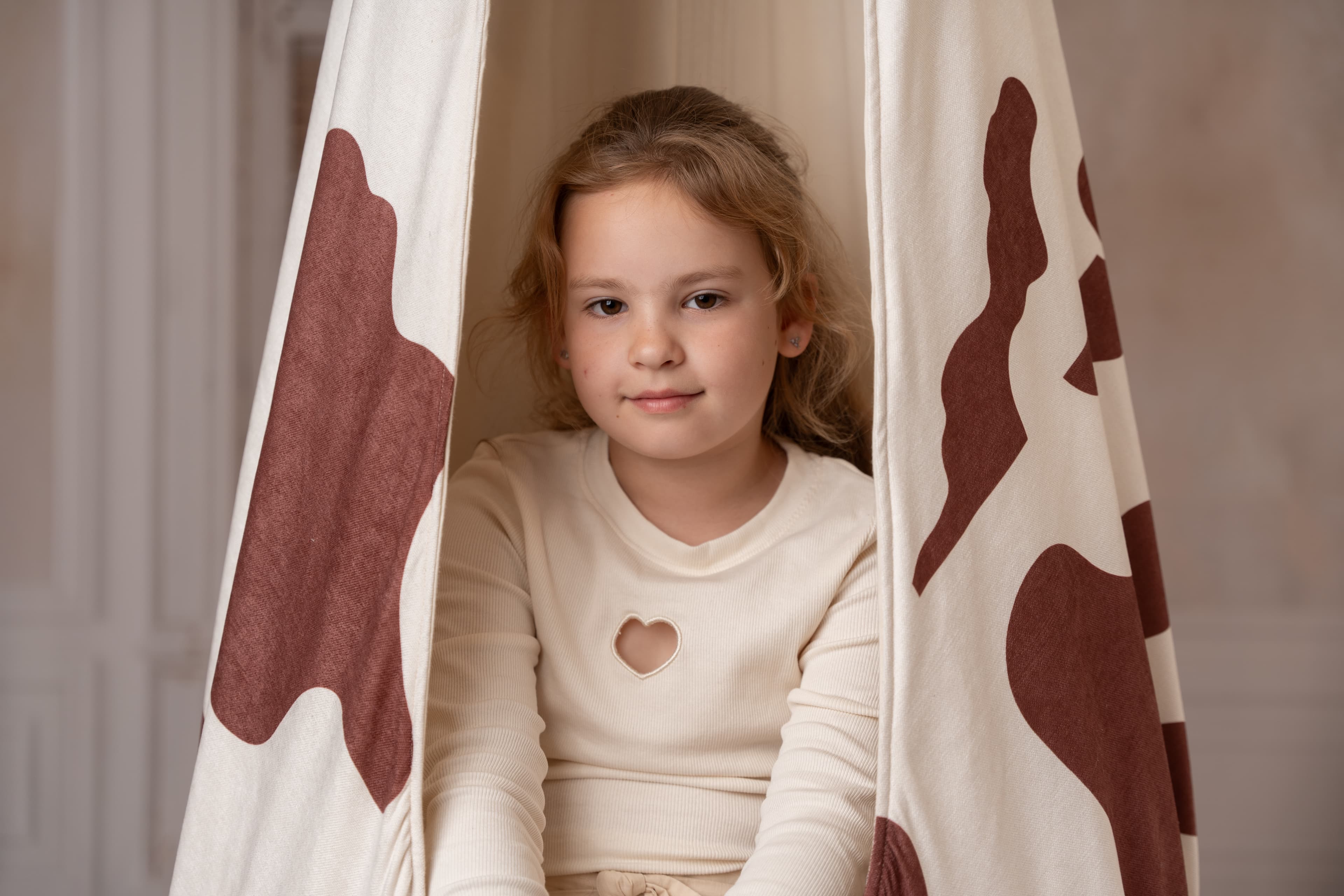
Cocoon swings are the better choice for sensory regulation. The partially enclosed shape provides proprioceptive input alongside the vestibular stimulation — the gentle pressure of the sides creates a snug, contained feeling that many children find deeply calming. Children who need a quiet space to decompress, or who are overwhelmed by open environments, respond particularly well to the cocoon shape.
Our [indoor cocoon swings](/shop/swings) are designed around this enclosed shape — a soft pod that rocks with every movement, creating a self-regulating sensory environment.
The Ceiling Attachment: The Most Important Practical Factor
The single most important practical consideration with any indoor kids swing is the ceiling attachment. This is not a detail — it's the primary safety point.
You need:
- A solid ceiling joist or beam, not just drywall. Drywall alone cannot support a swing.
- Fixings that go into the joist, not just into the plaster surface
- A swivel hook that allows rotation without twisting the rope or chain
Our cocoon swings hang from a sturdy loop and are designed for a single ceiling hook fixed into a joist. Standard joist finders make locating the beam straightforward. When in doubt, a carpenter can confirm the correct fixing point in minutes.
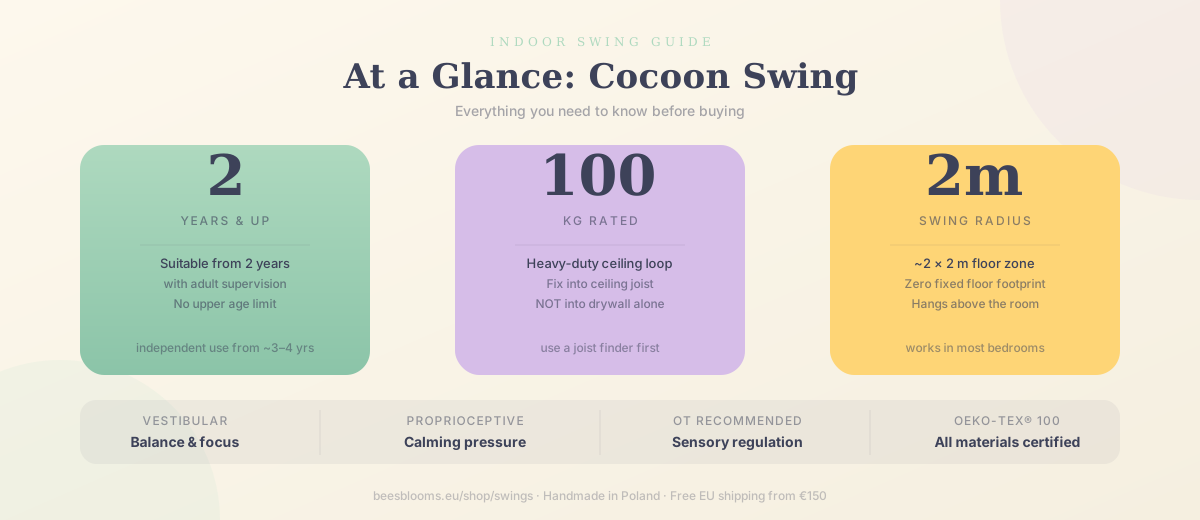
Always check the weight rating before buying any children's swing. Our swings are rated to 100 kg — well above what's needed for the intended age range, and sufficient to use through late childhood.
How Much Ceiling and Floor Space Do You Need?
Less than most people think.
Height: You need enough clearance for the swing length plus the seated child's position. In a standard 240 cm ceiling room, with a 60 cm rope, there's comfortable space for a toddler or child to swing without risk of touching the floor.
Floor radius: When in motion, a cocoon swing sweeps roughly 80–100 cm in each direction from the hang point. At rest, it takes no floor space at all — it simply hangs above the room.
In practice, the total dedicated floor "zone" is around 2 × 2 metres. A small bedroom corner can accommodate this.
At What Age Can a Child Use an Indoor Swing?
Cocoon swings are suitable for supervised use from approximately 2 years old. At this age, children have enough head and trunk control to sit safely in the enclosed shape.
Independent use — where a child manages getting in, out, and controlling the swing themselves — typically arrives around 3–4 years.
There is no firm upper age limit. Many primary school-age children continue to use cocoon swings and appreciate them for the same calming, focus-supporting properties as younger children.
Who Gets the Most From an Indoor Swing?
Some children take to swings immediately; others barely notice them. The children who typically benefit most are:
- Sensory-seeking children — those who rock, fidget, and seek physical input throughout the day
- Children with anxiety or overwhelm — the enclosed, rocking environment is a genuine calming tool used in occupational therapy contexts
- Children with sensory processing differences — cocoon swings are frequently recommended by OTs for proprioceptive and vestibular regulation
- Bookish, imaginative children — a cocoon swing becomes a reading pod, a pirate ship, or a rocket, depending on the day
For families where any of the above applies, an indoor swing is rarely a purchase that's regretted.
Browse our [cocoon swings for children](/shop/swings) — all OEKO-TEX® certified, rated to 100 kg, and designed for indoor use from 2 years.